
Castleman Disease Signs & Symptoms
Subscribe to the CDCN Newsletter
Go beyond Signs and Symptoms - Learn about CDCN, our efforts to cure Castleman disease, and how we help those suffering from the disease now. Sign up for our newsletter today!
Get to know Castleman Disease
Castleman disease is a group of rare disorders characterized by lymph node enlargement, specific microscopic changes to the lymph nodes, and a range of symptoms and laboratory findings.
Castleman disease has a broad spectrum of disease severity, ranging from mild compressive symptoms and fatigue to life-threatening multi-organ failure. Symptoms of Castleman disease often overlap with symptoms of other more common illnesses which makes diagnosis difficult.
A Castleman disease diagnosis can only be made with a lymph node biopsy that shows characteristic Castleman disease features and when all other illnesses have been evaluated and excluded.
Symptoms of unicentric Castleman disease (UCD)
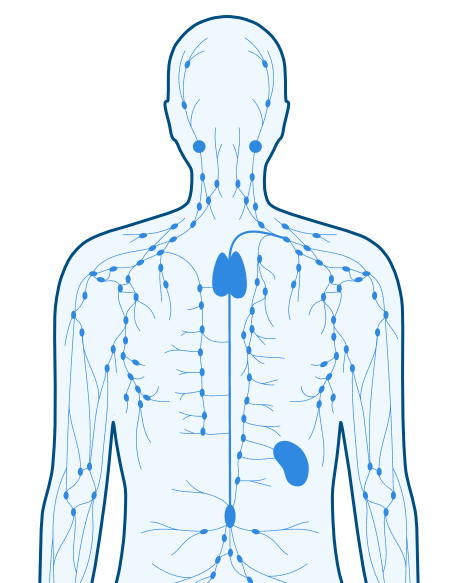
In unicentric Castleman disease (UCD), enlarged lymph nodes appear in only one region of the body.
- UCD symptoms tend to be mild and occur secondary to compression of surrounding structures by rapidly enlarging lymph nodes.
- Less commonly, some UCD patients can experience systemic inflammatory symptoms such as fatigue and laboratory abnormalities such as low hemoglobin and elevated C-reactive protein.
Symptoms of multicentric Castleman disease (MCD)
In multicentric Castleman disease (MCD), enlarged lymph nodes appear in multiple regions of the body. Symptoms occur due to a systemic hyperinflammatory response an tend to be more severe than UCD symptoms.

- Flu-like symptoms (fever, night sweats, loss of appetite, nausea, and vomiting)
- Unintentional weight loss
- Enlarged liver or spleen

- Peripheral neuropathy (numbness in the hands and feet)
- Edema (swelling), ascites (fluid accumulation in the abdomen), and/or other symptoms of fluid accumulation

- Weakness, fatigue
- Kidney dysfunction
- Cherry hemangioma skin rash
Diagnosis
Symptoms in CD often overlap with symptoms of many more common illnesses. This is why a Castleman disease diagnosis cannot be made with symptoms alone and requires further testing.
Lymph node biopsy
Diagnosis of CD requires an excisional lymph node biopsy that shows features of Castleman disease.
- “Excisional” means that the lymph node must be surgically removed entirely so that it can be specially prepared and evaluated by a pathologist.
Imaging
Shows how many lymph node are affected and can help to distinguish between UCD and MCD.
- CT scan: can detect enlarged lymph nodes
- PET-CT scan: uses a radiotracer to detect enlarged lymph nodes and the activity of those lymph nodes
Laboratory tests
- Complete blood count: hemoglobin, white blood cells, platelets
- Inflammation markers: CRP/ ESR
- Markers of organ function: liver function test, albumin, creatinine (tests kidney function), HIV/ HHV8 testing (used to test for HHV8-positive MCD).
© 2025 The Castleman Disease Collaborative Network | Privacy Policy | Terms of Use